

At 5:30 PM your crew leaves. Your site still has a skid steer, a stack of copper, a pallet of power tools, and a few hundred thousand dollars in materials. All of it sits behind a chain-link fence until morning.
That's when thieves go to work. Estimates of how much construction equipment is stolen each year run from $300 million to $1 billion, and that's machines only. Tools, materials, and damage aren't counted. Recovery rates are worse. Less than 25% of stolen equipment ever makes it back to its owner. For tools and small equipment, the rate falls below 7%.usassure+3
If you want to know how to secure equipment at a construction site overnight, the answer isn't one product. It's layers. Each layer makes your site harder, slower, and riskier to hit than the one down the road.
What thieves actually take from construction sites
You can't protect everything the same way, so start with what gets stolen most. The most common targets are copper and other metals, lumber, hand tools, power tools, and heavy machinery.
- Copper (wire, pipe, and fittings) is now the most valuable target on most sites. The main reason is commodity prices.
- Compact equipment like skid steers, mini excavators, backhoes, and wheeled tractors is easy to load onto a trailer and resell.
- Generators, compressors, welders, and light towers are portable and have few ID marks.
- Appliances, HVAC units, and plumbing fixtures get taken from construction sites late in the build.
- Cordless tools and batteries disappear fast, and nobody can trace them.
Theft also costs more than the stolen item. A single copper theft on a small project can add up to $12,500–$35,000 once you count rewiring, drywall repair, re-inspection, and delays. On large commercial jobs, delays alone can run close to $10,000 a day.
Step 1: Lock down the perimeter
Your fence doesn't stop a determined thief. It slows them down and pushes them toward one way in. That's the goal.
- Use 6–8 foot temporary fencing with clamps on every panel, not just every other one.
- Install one controlled gate with a heavy-duty chain and a shrouded padlock that bolt cutters can't reach.
- Remove gaps at the bottom and anything climbable, like pallets and debris piles, near the fence line.
- Add privacy screening so people driving by can't scope out your equipment.
- Post signs that say "24/7 video monitoring" and "trespassers prosecuted." Signs only work when real security backs them up.
Step 2: Light the site so there's nowhere to hide
Darkness is a thief's best friend. Bright, even lighting removes hiding spots and makes camera footage usable.
- Point lights at storage zones, equipment parking, gates, and material laydown areas.
- Use motion-activated floodlights at entry points so a sudden flash tells intruders they've been spotted.
- Pick solar or battery-powered light towers for sites without permanent power.
- Avoid harsh glare pointed straight at cameras, which can wash out the image.
Step 3: Park and store smart at end of day
How you shut down the site each day matters as much as any technology. Make it a checklist your superintendent signs off on every night.
- Park heavy equipment in a tight cluster, ideally in the middle of the site, with buckets and blades lowered to the ground.
- Use the largest machines to block in smaller, easier-to-steal units.
- Take keys home. Never leave them in the cab, under the seat, or in a "hidden" spot on the site.
- Install a battery disconnect, hydraulic lock, or ignition kill switch on high-value machines.
- Lock tools and small equipment in an anchored job box or conex. Use puck locks, which are harder to cut than standard padlocks.
- Keep copper and high-value materials inside a locked building or container. Schedule deliveries as close to installation as possible so materials don't sit on site.
- Remove ladders that give access to upper floors or roofs.
Step 4: Mark, record, and track your assets
When something does walk off, documentation decides whether you get it back.
- Record every serial number and PIN, and take photos. Register heavy equipment with the National Equipment Register, which helps police and insurers recover stolen machines.
- Etch or stamp your company ID on tools. Use paint or colored tape so your gear stands out on a resale site.
- Put GPS trackers on high-value machines and generators, and set geofence alerts for after-hours movement.
- Use Bluetooth or cellular tags for tool trailers and gang boxes.
GPS helps you recover gear after it's gone. It doesn't stop the theft. That's why the next step matters most.
Step 5: Use cameras that do more than record
Here's the hard truth: a recording-only camera mostly gives you footage of your loss. By the time anyone watches it the next morning, the thieves are long gone.
What stops theft overnight is detecting and responding in real time.
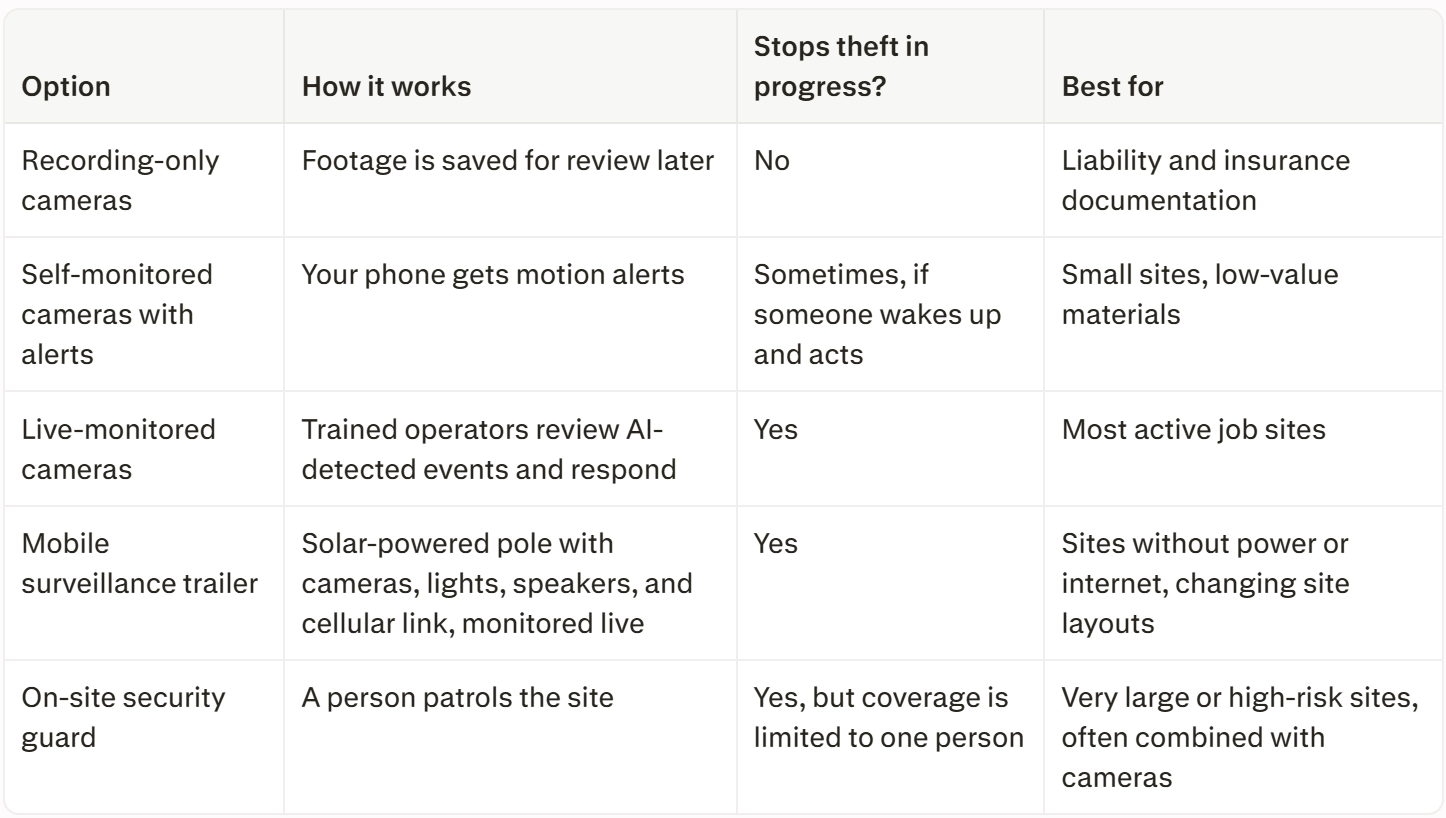
A good monitored system works like this:
- AI analytics spot a person or vehicle inside the site after hours. They filter out false alarms from wind, animals, and headlights.
- A live operator checks the video within seconds.
- Talk-down speakers warn the intruder that they're being watched and police are on the way.
- If they don't leave, police are sent with a verified crime in progress. Police usually respond much faster to verified video alarms than to unverified alarms.
Most thieves run the moment a voice calls them out. That's a loss prevented, not a loss documented.
For active job sites, mobile surveillance trailers are often the best fit. They run on solar power with battery backup, connect over cellular, and go up in about an hour. You can move them as the site changes from site work to framing to finishes.
Step 6: Be extra careful around holidays and weekends
Long weekends are prime time for theft. National Equipment Register data shows spikes around Memorial Day, Labor Day, and Thanksgiving. Before any long break:
- Move or remove the most valuable portable equipment.
- Double-check camera views, battery levels, and cellular signal.
- Tell your monitoring provider about the shutdown dates so they treat all activity as suspicious.
- Ask neighbors and the local police district to keep an eye out.
How much does overnight construction site security cost?
Costs depend on site size, risk, and how long the project runs. Here's a general breakdown:
- Basic measures (locks, lighting, job boxes, signs): a low one-time cost.
- GPS trackers: a small cost per asset plus a monthly data fee.
- Monitored camera systems or surveillance trailers: a monthly rental, often less than one night of guard coverage per week.
- Security guards: the highest hourly cost, and they can only see what's in front of them.
Compare that to one copper theft, which can cost up to $35,000 on a small project once you count all the damage. Insurance deductibles, higher premiums, and missed deadlines aren't even in that number.
Overnight construction site security checklist
- Fence fully clamped, with one locked gate
- Lighting on gates, equipment, and materials
- Equipment clustered, blades down, keys removed
- Kill switches on high-value machines
- Tools in anchored, puck-locked job boxes
- Copper and high-value materials locked up or delivered just in time
- Serial numbers recorded and registered with NER
- GPS trackers with geofence alerts
- Mobile surveillance trailer with talk-down
- Holiday shutdown plan shared with your monitoring provider
Frequently asked questions
What is the best way to secure construction equipment overnight?
Use layers: fencing, lighting, good parking habits, kill switches, GPS tracking, and live-monitored cameras that can stop a theft in progress. No single measure is enough on its own.
Do security cameras really prevent construction site theft?
Recording-only cameras mostly help after the fact. Live-monitored cameras with AI detection, talk-down speakers, and police dispatch can stop thieves before they load anything.
How do I protect copper on a construction site?
Schedule deliveries close to installation and store copper in locked containers or locked rooms. Cover the storage area with monitored cameras, and keep a record of what's on site.
Are mobile surveillance trailers worth it for construction sites?
For most active sites, yes. They need no power or internet, set up quickly, move as the project changes, and cost less than overnight guards.
What should I do if equipment is stolen?
Call police right away with serial numbers, photos, and GPS data. Then notify your insurer and the National Equipment Register. Speed matters, because the odds of recovery drop sharply after the first day.
Protect your site before you need to
Thieves look for easy targets. A dark, quiet site with keys in the cab and copper on a pallet is about as easy as it gets. A monitored, well-lit site with a voice that calls them out is not.
Autom Security protects construction sites across Ohio, Kentucky, and Indiana with solar-powered surveillance trailers, AI detection, and live overnight monitoring.